
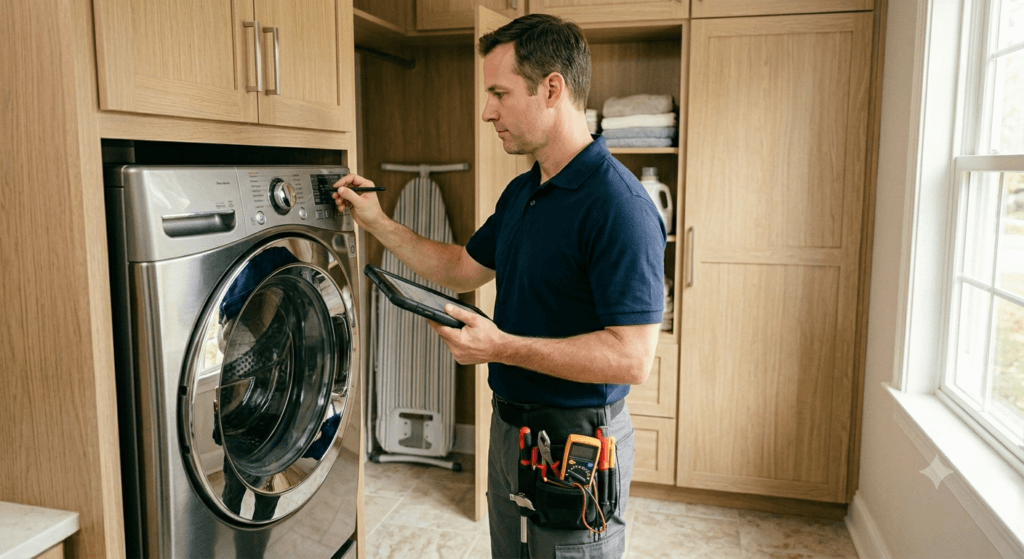
A washing machine that vibrates so intensely it walks across the floor, bangs against the wall, or sounds like something is about to break loose is communicating a real mechanical issue. While all washing machines produce some vibration during the spin cycle, violent shaking is not normal operation, it is a symptom.
Identifying the cause of excessive washing machine vibration requires understanding which systems are involved. Here is what our technicians at Home Appliance Care typically investigate during a vibration diagnostic.
1. The Load Is Unbalanced
The most common cause, and the one that requires no repair. When heavy items like towels, jeans, or a single large comforter shift to one side of the drum during spinning, the resulting weight imbalance creates a vibration that grows more intense as spin speed increases.
If the machine shakes with large or heavy loads but operates normally with mixed loads, experiment with how you load the drum. Distribute heavy items evenly around the drum rather than placing them all together. Use the appropriate cycle setting for heavily loaded drums.
If shaking occurs even with properly distributed loads, the problem is mechanical.
2. The Shock Absorbers Are Worn
Washing machines use shock absorbers to dampen the movement of the inner drum during the spin cycle. As these absorbers wear, they lose their ability to control drum movement. A machine with failed shock absorbers allows the drum to move dramatically, creating the thumping and banging sounds you hear against the cabinet sides.
Shock absorber wear is one of the most common causes of washing machine vibration in machines over five years old. Replacement is a routine repair that dramatically reduces noise and vibration. On most machines, the absorbers are accessed by removing the back or front panel.
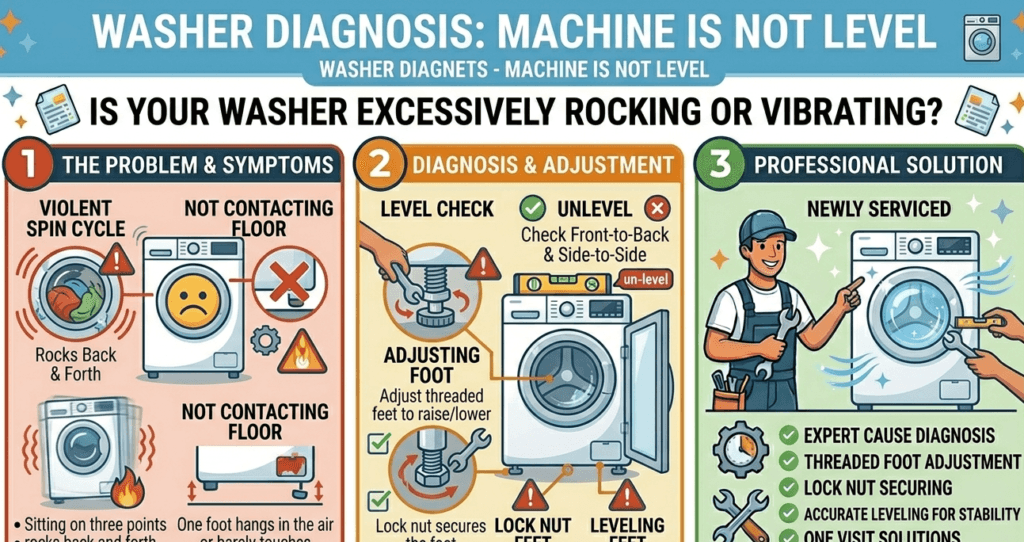
3. The Machine Is Not Level
All four feet of a washing machine must contact the floor evenly. A machine sitting on three points, one foot hanging in the air or barely touching, rocks back and forth during the spin cycle. What feels like a violent vibration problem often disappears entirely after ten minutes of leveling work.
Use a level placed on top of the machine (front-to-back and side-to-side) to check whether it is sitting flat. Adjust the leveling feet, they are threaded and turn to raise or lower each corner, until the machine sits perfectly level. Lock each foot in place with its locking nut after adjustment.
4. The Drum Bearings Are Worn
Drum bearings allow the inner drum to spin smoothly within the outer tub. When they wear out, the drum can wobble on its axis during the spin cycle. This wobble causes the drum to make contact with surrounding components and generates a rhythmic thumping or grinding that intensifies with spin speed.
Bearing failure typically develops gradually. The first sign is often a faint grinding noise that appears during spinning and grows louder over weeks or months. If left unaddressed, failed bearings cause damage to the drum shaft, outer tub, and suspension system, turning a bearing replacement into a much larger repair.
5. The Suspension Springs Are Damaged
Top-load washing machines use suspension springs to support the drum assembly from the top of the cabinet. These springs allow the drum to move slightly during operation while keeping it centered. If one or more springs break or become detached, the drum sits unevenly and generates significant vibration during spinning.
A broken suspension spring typically produces a sudden change in the machine’s behavior, one cycle it runs normally, the next cycle it shakes badly. Visually inspecting the springs requires opening the machine cabinet, which is straightforward for a technician but not always obvious for homeowners.
6. The Floor Surface Is Contributing
Washing machines installed on soft flooring like vinyl, cork, or worn hardwood can vibrate more than those on solid concrete or tile. The floor flexes under the machine’s movement and amplifies vibration rather than absorbing it. Anti-vibration pads placed under each foot reduce this significantly and are worth trying as a first step on any floor type.
7. Worn Drum Support Rollers
Front-load washers use drum support rollers at the back (and sometimes front) of the drum to support its weight as it spins. Worn rollers develop flat spots and create a thumping rhythm that is noticeable at all spin speeds. Replacing rollers in sets is the standard approach when wear is identified.
Ready to schedule a repair? Contact Home Appliance Care today. We serve the entire Home area (DC, Maryland & Virginia). Call us at (571) 206-1560 for fast, same-day appliance repair.