
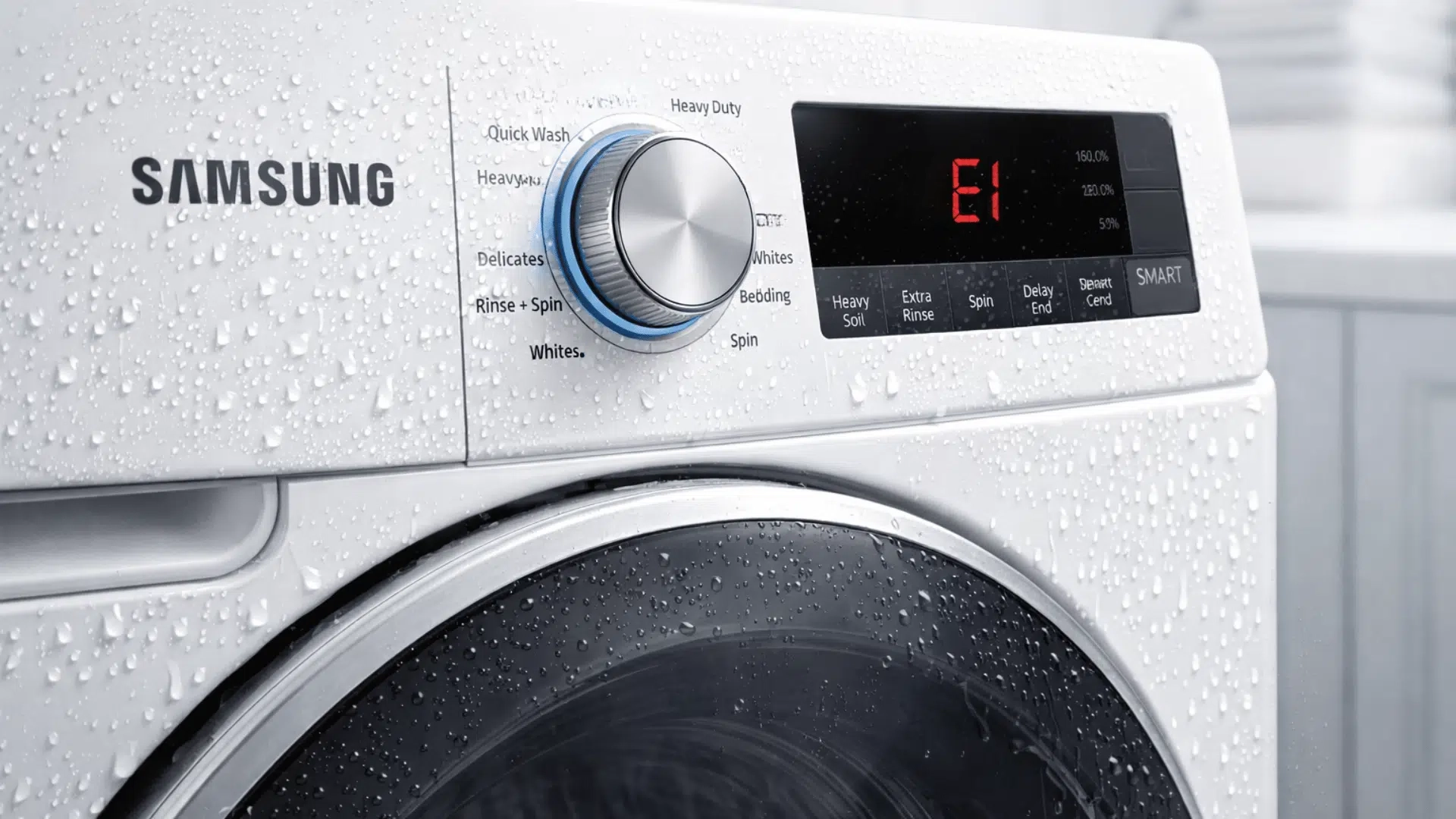
Nothing is more frustrating than loading your Samsung washing machine, pressing the Start button, and watching an E1 error code appear instead of a normal wash cycle. Whether you’re trying to finish laundry before work or preparing clothes for the week ahead, a washer that won’t fill with water can quickly disrupt your routine.
The good news is that an E1 error on a Samsung washer is often related to the water supply system, and many causes can be identified with a few simple checks. In some cases, the problem may be as straightforward as a partially closed water valve or a kinked inlet hose. In other situations, the issue may involve a clogged inlet filter, a faulty water inlet valve, or an internal component that requires professional repair.
Understanding what the E1 error means is the first step toward fixing it correctly. Replacing parts without diagnosing the real cause can waste both time and money. A systematic approach helps identify the source of the problem and ensures the right repair is made.
In this guide, we’ll explain:
- What the Samsung washer E1 error code means
- The most common reasons it appears
- Simple troubleshooting steps you can perform at home
- When professional washer repair is the safest option
- How to prevent the E1 error from happening again
By the end of this article, you’ll have a clear understanding of what causes the error, which repairs you can safely attempt yourself, and when it’s time to call an experienced appliance technician.
What Does the Samsung Washer E1 Error Code Mean?
The Samsung washer E1 error code indicates that the washing machine is not receiving enough water within the expected amount of time. During the beginning of every wash cycle, the control board monitors how quickly water enters the drum. If the washer cannot detect the correct water level within a set period, it stops the cycle and displays the E1 error to protect the appliance.
On many newer Samsung washing machine models, you may see 4E, 4C, or nF instead of E1. Although the code displayed may differ depending on the model and production year, these error codes generally point to the same issue, a problem with the washer’s water supply.
The E1 error does not always mean that a part has failed. In many cases, the washer is simply unable to receive enough water because of an external issue. For example, the household water faucet may not be fully open, the inlet hose may be bent or blocked, or the water pressure may be lower than the machine requires.
However, if the external water supply is working normally, the problem could be caused by an internal component such as:
- A clogged water inlet filter
- A faulty water inlet valve
- A malfunctioning pressure sensor
- A damaged wiring connection
- A defective electronic control board
Because several different problems can produce the same error code, proper diagnosis is essential before replacing any parts.
Common Signs That Accompany the E1 Error Code
The E1 error rarely appears without other warning signs. Paying attention to these symptoms can help narrow down the possible cause and make troubleshooting much easier.
The Washer Doesn’t Fill With Water
This is the most obvious symptom. After selecting a wash cycle, the machine starts but little or no water enters the drum before the error appears.
The Wash Cycle Stops Shortly After Starting
The washer may lock the door and begin the cycle but automatically stop after detecting that the required water level has not been reached.
You Hear the Water Valve Activate, but No Water Enters
In some cases, you’ll hear the machine attempting to fill, yet no water flows into the drum. This often points to a blocked water supply, clogged inlet screen, or water inlet valve problem.
Water Fills Very Slowly
Low household water pressure or partially blocked hoses may allow some water into the washer, but not enough to satisfy the control system within the required time.
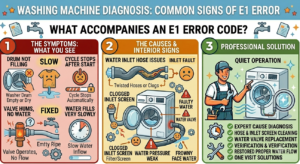
The Error Appears Intermittently
If the E1 error only occurs occasionally, fluctuating water pressure, loose hose connections, or debris in the inlet filter may be affecting water flow.
Recognizing these symptoms early can help prevent unnecessary repairs and reduce the risk of interrupting future wash cycles.
What Causes a Samsung Washer to Display the E1 Error?
Although the E1 code points to a water supply problem, there isn’t just one possible cause. Several components work together to deliver the correct amount of water into the washing machine, and a failure anywhere along this system can trigger the error.
The most common causes include:
- Household water supply turned off
- Low water pressure
- Kinked or pinched water inlet hoses
- Clogged inlet hose mesh filters
- Dirty water inlet screens
- Faulty water inlet valve
- Frozen or blocked water lines
- Pressure sensor problems
- Loose electrical wiring
- Electronic control board malfunction
Fortunately, many of these issues can be identified through simple troubleshooting before considering more complex repairs.
Quick Answer
If your Samsung washer shows the E1 error code, first check that both water supply faucets are fully open, inspect the inlet hoses for kinks or blockages, clean the inlet mesh filters, and confirm that your home’s water pressure is adequate. If the error remains after these checks, the washer may require professional diagnosis to inspect the water inlet valve, pressure sensor, or control board.
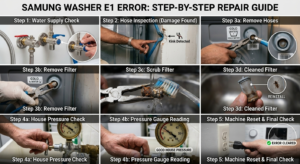
Step-by-Step Guide to Repair a Samsung Washer With Error Code E1
If your Samsung washer displays the E1 error code, don’t assume the appliance is permanently damaged. In many cases, the issue can be resolved by checking a few common water supply components before replacing any parts.
Follow these troubleshooting steps in order. Start with the simplest checks first, as they are often the quickest and least expensive to fix.
Step 1: Check That the Water Supply Is Turned On
The E1 error usually appears because the washer isn’t receiving enough water during the filling stage.
Begin by checking both the hot and cold water supply valves connected behind the washer.
Make sure:
- Both faucets are fully open.
- Water is flowing normally.
- No recent plumbing work has affected the water supply.
If another faucet in your home also has weak water flow, the problem may be with your household plumbing rather than the washing machine.
Step 2: Inspect the Water Inlet Hoses
Next, examine both inlet hoses carefully.
Over time, a washing machine may gradually move during spin cycles, causing the hoses behind it to become:
- Bent
- Twisted
- Crushed
- Pinched against the wall
Any restriction reduces water flow and may trigger the E1 code.
Look carefully for:
- Sharp bends
- Visible damage
- Bulges
- Leaks
- Loose connections
If a hose appears damaged, replacing it is usually the safest solution.
Step 3: Clean the Water Inlet Mesh Filters
One of the most overlooked causes of an E1 error is a clogged inlet screen.
Samsung washers have small mesh filters where the inlet hoses connect to the machine. These filters prevent sand, rust, and mineral deposits from entering the internal water valve.
Over months or years, debris can build up and significantly reduce water flow.
To clean the filters:
- Turn off both water supply valves.
- Disconnect the inlet hoses.
- Carefully remove the mesh filters using needle-nose pliers if necessary.
- Rinse the filters under running water.
- Use a soft brush to remove mineral buildup.
- Reinstall the filters.
- Reconnect the hoses securely.
Never operate the washer without these filters installed.
Step 4: Check Household Water Pressure
Samsung washing machines require adequate water pressure to fill properly.
If water pressure is too low, the control board may assume there is a problem with the water supply and display the E1 error.
Signs of low water pressure include:
- Faucets running slowly
- Weak shower pressure
- Washer filling very slowly
- Long delays before the wash cycle begins
If multiple plumbing fixtures are affected, you may need to contact your local water provider or a licensed plumber.
Step 5: Reset the Washing Machine
Occasionally, the washer’s electronic control system may display an error even after the original issue has been resolved.
Try performing a simple reset.
- Turn the washer off.
- Unplug it from the electrical outlet.
- Wait about 5 minutes.
- Plug it back in.
- Restart the wash cycle.
If the error disappears, it may have been caused by a temporary communication issue.
If the E1 code returns immediately, additional diagnosis will likely be necessary.
What If the Error Still Doesn’t Go Away?
If you’ve completed the basic troubleshooting steps and your Samsung washer still displays the E1 error code, the problem is likely inside the appliance.
Several internal components control how water enters the machine. When one of these parts fails, the washer may stop filling correctly even though the household water supply is working normally.
Faulty Water Inlet Valve
The water inlet valve controls the flow of water into the washing machine.
When this valve begins to fail, it may:
- Open only partially
- Open intermittently
- Fail to open at all
Because the washer cannot receive enough water within the programmed time, the control system triggers the E1 error.
Common signs include:
- Very slow filling
- No water entering the drum
- Intermittent filling problems
- Buzzing from the rear of the washer
Replacing the inlet valve is a repair best handled by an experienced appliance technician.
Blocked Internal Water Passage
Although less common, internal water passages may become restricted by:
- Hard water deposits
- Mineral buildup
- Sediment
- Debris
These blockages reduce water flow even when the external hoses appear normal.
Professional cleaning may be required if internal passages have become severely restricted.
Pressure Sensor Problems
The pressure sensor monitors the amount of water entering the drum.
If it provides inaccurate readings, the washer may mistakenly believe there isn’t enough water inside, even when the drum has filled correctly.
Symptoms often include:
- Repeated E1 errors
- Inconsistent filling
- Wash cycles stopping unexpectedly
- Water filling longer than normal
Damaged Wiring Connections
Loose or damaged wiring between the control board and water inlet system can interrupt communication between components. Although wiring failures are less common than clogged filters or faulty valves, they should be inspected whenever other causes have been ruled out.
Electronic Control Board Failure
The control board serves as the washer’s central computer.
It controls:
- Water filling
- Cycle timing
- Drain functions
- Spin cycles
- Error detection
If the control board develops a fault, it may incorrectly display the E1 error even when all other components are functioning properly. Control board diagnosis requires specialized testing and should generally be performed by a qualified appliance repair technician.
When Should You Call a Professional Appliance Repair Technician?
Many homeowners can safely inspect water supply valves, hoses, and inlet filters. However, once troubleshooting moves beyond these basic checks, professional service is often the safest and most effective solution.
Consider scheduling professional Samsung washer repair if:
- The E1 error continues after completing all basic troubleshooting steps.
- Water supply and pressure are normal, but the washer still won’t fill.
- The water inlet valve appears to have failed.
- The washer repeatedly displays the same error after being reset.
- You notice burning smells, electrical issues, or unusual noises.
- Water leaks from inside the machine.
- The appliance stops during every wash cycle.
Modern Samsung washing machines contain sophisticated electronic controls and internal components. Attempting complex repairs without the proper tools or experience can sometimes create additional problems.
A trained appliance technician can accurately diagnose the issue, test individual components, and recommend the most cost-effective repair without unnecessary parts replacement.
Safety Tips Before Repairing Your Samsung Washer
Before inspecting or repairing any washing machine, always prioritize safety.
Follow these precautions:
- Unplug the washer before inspecting internal components.
- Turn off both hot and cold water supply valves.
- Never disassemble electrical components unless you are qualified to do so.
- Avoid forcing connectors, hoses, or plastic fittings.
- Keep the floor dry to reduce the risk of slipping or electrical hazards.
- If you notice burning smells or visible wiring damage, discontinue troubleshooting and contact a professional immediately.
A careful, step-by-step approach helps protect both your appliance and your safety.
How to Prevent the Samsung Washer E1 Error Code
The best way to avoid seeing the E1 error code again is through regular maintenance. Since this error is usually related to the washer’s water supply, keeping the water inlet system clean and unrestricted can significantly reduce the likelihood of future problems.
Fortunately, most preventive maintenance only takes a few minutes and can help extend the life of your washing machine.
Inspect the Water Inlet Hoses Regularly
Every few months, take a quick look behind the washer to ensure the water inlet hoses are in good condition.
Check for:
- Kinks or bends
- Cracks or bulges
- Signs of leaks
- Loose connections
Replacing worn hoses before they fail can prevent both error codes and unexpected water damage.
Clean the Inlet Mesh Filters
Over time, minerals, sand, rust, and debris from your home’s water supply can collect inside the inlet mesh filters. Cleaning these filters every six to twelve months helps maintain proper water flow and reduces strain on the water inlet valve.
Homes with hard water may require more frequent cleaning.
Maintain Good Water Pressure
Samsung washers perform best when connected to a steady water supply with adequate pressure. If you notice reduced water flow throughout your home, addressing plumbing issues promptly can help prevent washer filling errors.
Avoid Slamming the Washer Against the Wall
Heavy spin cycles may gradually cause the appliance to shift backward.
Leaving a small amount of space behind the washer helps prevent the inlet hoses from becoming pinched or crushed.
Schedule Professional Maintenance
Having your washing machine inspected periodically allows small problems to be identified before they become expensive repairs.
A professional technician at Home Appliance Care can inspect the water inlet system, valves, hoses, pressure sensor, and other key components to ensure everything is operating correctly.
Should You Repair or Replace a Samsung Washer Showing the E1 Error?
Many homeowners worry that an error code means their washing machine has reached the end of its life. Fortunately, that’s rarely the case with the Samsung washer E1 error.
Because the E1 code usually relates to the water supply system rather than the motor or transmission, many repairs are relatively straightforward and cost-effective.
Repair Is Often the Better Choice When:
- The washer is less than 10 years old.
- The appliance has otherwise been reliable.
- The problem involves the water inlet valve, mesh filters, hoses, or pressure sensor.
- Repair costs are much lower than purchasing a new washer.
- The machine is in good overall condition.
Many E1-related repairs can restore normal performance without replacing the entire appliance.
Replacement May Be Worth Considering When:
Although less common, replacement might make sense if:
- The washer has experienced multiple major repairs in recent years.
- The control board and several additional components have failed simultaneously.
- Repair costs approach the value of a new machine.
- The washer is nearing the end of its expected lifespan.
- Severe corrosion or structural damage is present.
A qualified appliance technician can inspect the machine and recommend the most practical solution based on its condition.
Frequently Asked Questions About the Samsung Washer E1 Error Code